
Many older electrical panel brands installed throughout the mid-20th century are now known for safety risks, reliability concerns, or parts that are no longer available. If your home uses one of these panels, understanding their history and common issues can help you make informed decisions about upgrades and safety.
Below is a breakdown of several panel brands frequently encountered in older homes, what issues they’re known for, and what to look for during an inspection.
Federal Pacific (FPE)
Common era: ~1950s–1980s
Notable feature: “Stab-Lok” breakers
Federal Pacific Electric panels are one of the most widely installed older panel types in the U.S., but they are also associated with serious reliability concerns.
Key Issues
- High documented failure rates during investigations and home inspections.
- Breakers have been shown to fail to trip during overloads or short circuits.
- Some reports indicate 25–60% failure under certain conditions.
- Design and material flaws include inadequate bus-bar contact, poor manufacturing oversight, and mis-testing in past decades.
- Homes with FPE panels may face insurance or real-estate challenges.
What to Look For
- Panel labelled “Federal Pacific Electric” or “Stab-Lok.”
- Older-looking panel (many are 40+ years old).
- Overheating signs such as burn marks, melted plastic, corrosion.
- Modifications, missing parts, or parts no longer available.
Pushmatic
Common era: ~1950s–1970s
Notable feature: Push-button breakers
Pushmatic panels use a unique push-button breaker design rather than traditional toggles.
Key Issues
- Considered obsolete; parts are hard to find.
- No major documented hazard like FPE/Zinsco, but reliability is questionable due to age and wear.
What to Look For
- Panel labelled “Pushmatic” or “Bulldog.”
- Rectangular push-button breakers instead of switches.
- General age-related wear or overheating.
- Even without visible flaws, consider long-term life-cycle risks for modern electrical loads.
Zinsco (Sylvania/Zinsco)
Common era: ~1960s–1970s
Notable feature: Distinctive breaker handle colors (red/green/blue)
Zinsco panels are widely cited by home inspectors as problematic.
Key Issues
- Breakers may fail to trip because they lose secure bus-bar connection.
- Some breakers may remain energized even when switched off.
- Bus bars—especially aluminum—may corrode or melt.
- Breakers can fuse to the bus bar, making servicing hazardous.
- Many parts are obsolete and the design is not suited for modern loads.
What to Look For
- Panel labelled “Zinsco” or “Sylvania/Zinsco.”
- Colored breaker handles.
- Any signs of arcing, melting, or bus-bar damage.
- Wiring age and capacity concerns, especially for large modern loads (A/C, EV charger).
- Older installations (40–50+ years).
Challenger
Common era: ~1980s–1990s
Key Issues
- 1988 recall of approximately 9,000 GFCI breakers (HAGF-15/20) for internal mechanical issues that prevented proper ground-fault operation.
- Some reports of overheating, bus-bar damage, and insurance concerns.
- Not as severely flagged as FPE or Zinsco but still requires careful evaluation.
What to Look For
- Panel labelled “Challenger” or “Eaton/Challenger.”
- Original breakers from the 1980s–1990s.
- Burn marks, discoloration, bus-bar damage.
- Presence of recalled breaker types and availability of replacement parts.
Wadsworth
Common era: ~1930s–1950s
Key Issues
- Company ceased operations by 1990; parts are obsolete.
- Panels are very old—often 60–70+ years.
- Even without major documented defects, age alone makes reliability questionable.
- May not meet modern safety requirements (grounding, AFCI/GFCI, load capacity).
What to Look For
- Panel labelled “Wadsworth.”
- Very old installation, often original to mid-century homes.
- Wear, corrosion, outdated wiring, lack of modern safety features.
- Replacement is often wise during major upgrades or home sales.
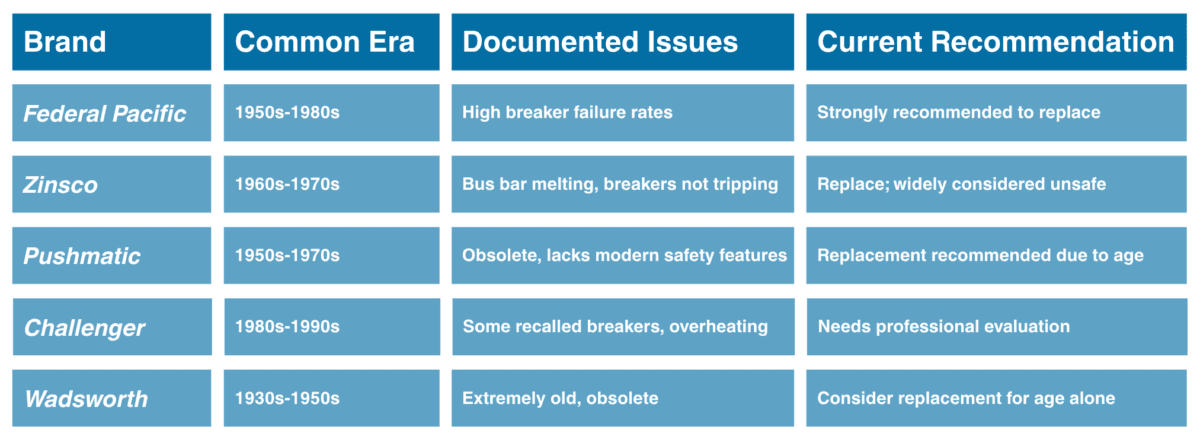
What This Means for You
- Age matters: Panels 50–70+ years old are at far higher risk due to wear, outdated standards, and lack of parts.
- Brand identification helps: Knowing which panel you have is the first step in understanding risk.
- Modern electrical loads are higher: Many older panels weren’t built for today’s household demands.
- Insurance & real-estate issues are possible: Especially with FPE and Zinsco panels.
- Professional evaluation is recommended: A licensed electrician can check bus bars, breaker operation, heat damage, and code compliance.
- Replacement may be more cost-effective than repair: Particularly when dealing with obsolete parts, known defects, or modern load requirements.
Have Questions? Contact Donatello Electric
If you’re unsure which electrical panel your home has, or if you want a professional evaluation, Donatello Electric is here to help.
📞 Call us anytime at 630-546-9944 with your questions or to schedule an inspection.